Real people. Real data. Real results.
What One Golfer Taught Us About Rhythm
Transformation Vault Series – Week 5
Most golfers believe their struggles come from a lack of strength, flexibility, or technical knowledge.
In reality, one of the most common causes of inconsistency has nothing to do with any of those things.
It is rhythm.
This article is based on real coaching evidence from Proper Golfing and tells the story of a golfer whose swing did not fall apart because he did not know enough, but because timing and coordination quietly disappeared.
If you have ever felt rushed over the ball, out of sync, or as though your swing starts before your body is ready, this will feel familiar.
The Golfer Who Had Everything Except Rhythm
The golfer in question was committed, practiced regularly, and understood the golf swing well.
He was not short of effort, practice time, or technical knowledge.
In fact, he had too much information.
Yet his swing kept breaking down.
Not occasionally, but consistently.
What had gone unnoticed was that his timing had slowly eroded. The swing was no longer flowing as one coordinated movement. Instead, urgency had crept in, particularly at the start of the downswing.
And when rhythm goes, everything feels fragile.
The Trap of Trying Harder
Like many golfers, he noticed a drop in distance and responded in the most natural way possible. He tried harder.
He swung faster.
He added effort.
He chased speed.
But effort did not bring power back.
It did the opposite.
Urgency increased, coordination disappeared, tension rose, and misses became more frequent. The swing lost its natural sequencing, and the club no longer arrived at the ball in sync with the body.
This is a pattern seen repeatedly in amateur golf.
More effort does not create more power when rhythm is lost.
The Hidden Habit Behind the Breakdown
During reflection, a deeper pattern emerged.
The golfer regularly hit very large volumes of balls on the range. Not deliberately, but habitually.
It traced back to something surprisingly ordinary. Being taught as a child that you must finish everything on your plate.
That habit had simply transferred to golf.
If the balls are there, I should hit them all.
The problem was not practice itself. It was unmindful repetition carried out at speed, under fatigue, with no space for awareness or coordination.
Hitting more balls was not improving the swing.
It was reinforcing poor rhythm.
Why Positions Did Not Help
One of the most important lessons from this case is that the solution was not technical.
No positions were added.
No swing rebuild was required.
No mechanical checklist was introduced.
Instead, the focus shifted to pace.
At Proper Golfing, we do not coach positions first. We coach movement.
Golf is not a static activity. Unlike yoga or strength training, it happens in motion. Movement requires timing, flow, and coordination, not static checkpoints.
This is where many golf lessons fail, particularly for maturing golfers.
The Shift That Changed Everything
The coaching intervention was simple but uncomfortable at first.
The golfer was asked to slow the swing down significantly, reduce ball numbers dramatically, remove judgement of strike quality, and stop reacting emotionally to outcomes.
What felt like half speed internally was only slightly slower in reality.
But the effect was profound.
As speed reduced, tension dropped, coordination returned, rhythm became visible again, strike quality improved, and distance returned naturally.
Nothing was forced.
The swing began to organise itself again.
Why Slowing Down Often Increases Speed
This is one of the great paradoxes of the Timeless Golf Swing®.
When rhythm improves, the body and club move together. Energy transfers efficiently. The club arrives at the ball with better sequencing, better contact, and less resistance.
Ironically, swing speed often increases, not because the golfer tries harder, but because nothing is fighting the motion anymore.
Effort is replaced with flow.
The Importance of the Finish
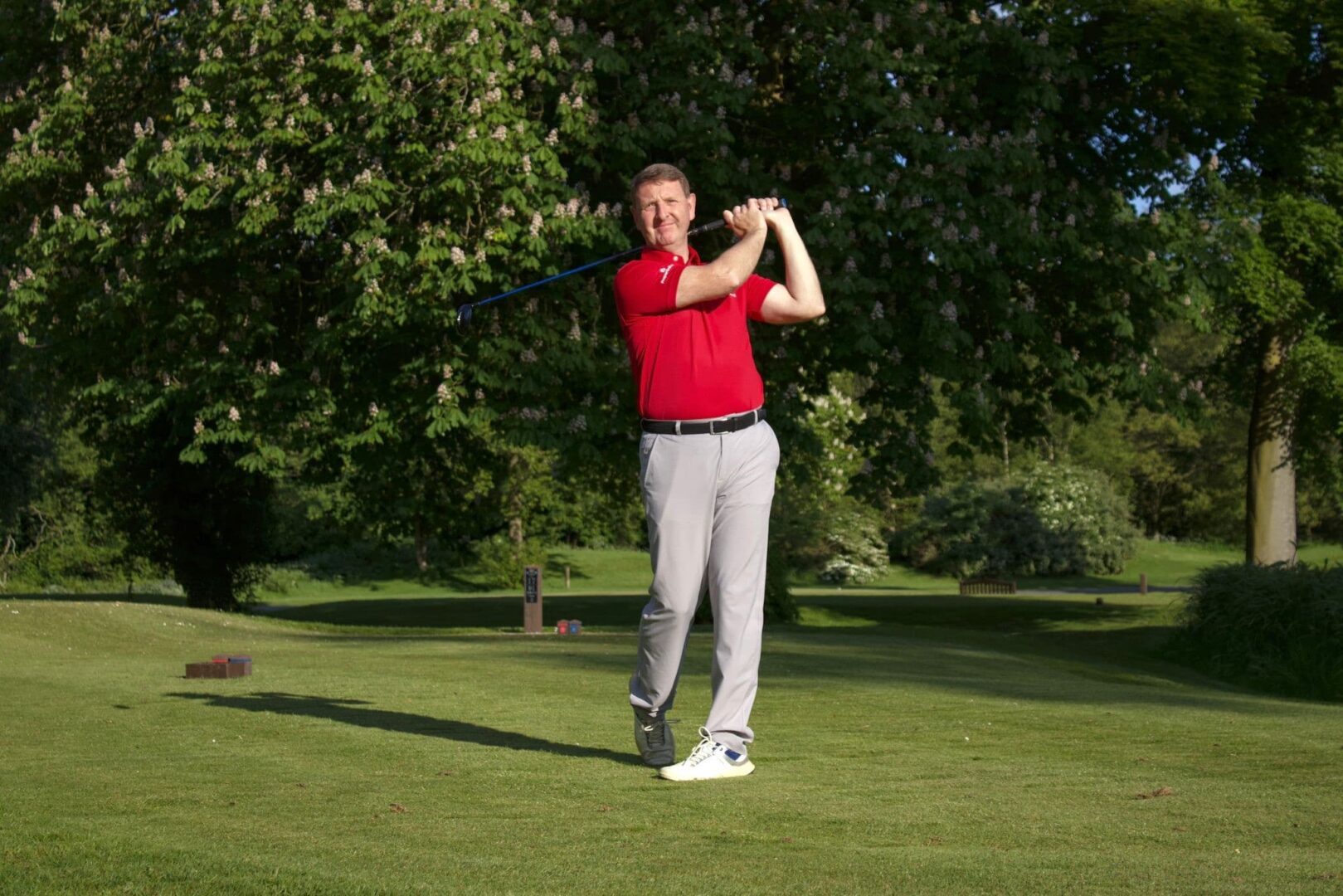
One key anchor in restoring rhythm is the finish.
At Proper Golfing, the finish is not an afterthought. It is a diagnostic.
Holding a balanced finish for six seconds reveals whether weight has transferred properly, whether balance is stable, and whether the body and club have worked together.
If a golfer is rushing, they cannot hold the finish.
That alone tells the story.
Most golfers rate the finish as unimportant. We rate it as essential.
A Simple Test for Your Own Swing
Here is a question worth asking the next time you practise or play.
How much did I enjoy that swing?
Score it out of 10.
Do this over several sessions, not just once.
Enjoyment is not a soft metric. It is a powerful indicator of rhythm, coordination, and tension levels. When swings feel good, they are usually working well.
Rhythm Is What Makes Golf Sustainable
When rhythm is right, golf feels easier. Contact improves. Distance returns. Tension drops. Confidence grows. Enjoyment comes back.
Golf stops feeling like a battle.
This is why the Timeless Golf Swing® focuses on pace, coordination, habits, and finish, rather than forcing positions or chasing mechanics.
Rhythm is not a luxury in the golf swing.
It is the glue that holds everything together.
Want to Go Deeper?
Many of the breakthroughs described in this article are supported by in-depth coaching videos inside the Proper Golfing video library. To access these videos and the full Proper Golfing video library, you can join the Virtual Academy here:
https://propergolfing.com/virtual-academy/
These videos are not generic tips. They are built from real coaching sessions, real golfers, and real patterns observed repeatedly over time. They focus on rhythm, pace, habit change, coordination, and the six-second finish, which sit at the heart of the Timeless Golf Swing®.
Some particularly relevant videos include:
1% Marginal Gains for Continued Improvement
https://my.propergolfing.com/lessons/1-marginal-gains-for-continued-by-improvement
Swing Killers: 8-Point Swing Check
https://my.propergolfing.com/lessons/1-swing-killers-8-point-swing-check
1/2 to 3/4 Full Swing Exercise
https://my.propergolfing.com/lessons/1-2-3-4-full-swing-exercise
10 Ways to Hit a Bad Shot Before You Make a Swing
https://my.propergolfing.com/lessons/10-ways-to-hit-a-bad-shot-before-you-make-a-swing
The Six-Second Finish
https://my.propergolfing.com/lessons/the-six-second-finish
These videos sit behind the Proper Golfing members wall and form part of a wider learning environment designed to help golfers improve without forcing positions or overthinking technique.
If the ideas in this article resonated with you, these videos will help you experience the change, not just read about it.
Interested to read more? Senior golf lessons: Golfers Deserve Better. This Is Where It Begins – Proper Golfing
More here How to Create a STABLE Club Face Every Time – Golf Tip
.
See our real transformations here
To book our personalised golf coaching experience, go here Proper Golfing
To listen to more podcasts on Apple – go here https://podcasts.apple.com/gb/podcast/the-proper-golfing-podcast-with-author-pga/id1614221973
See you on the tee,
Julian and Jo – Co-Creators of Proper Golfing and The Timeless Golf Swing Method
Proper Golfing
The leaders in real-world golf transformation for golfers over 50. No fluff. Just results