Why Does Your Golf Swing Disappear on the Course?

Why Does Your Golf Swing Disappear on the Course?
You can hit the ball beautifully on the range, then lose your golf swing the moment you step onto the course. The answer is not always what you think.
Julian: “What would make you rush, do you think, on a golf course?”
Ian: “I think it’s probably wanting to be really good.”
Julian: “So maybe the tension was coming back in?”
Ian: “Probably, yeah. It’s probably not having my consistent routine.”
That conversation took place during a lesson at my Proper Golfing Studio in Leamington Spa in October 2025.
Ian had been struggling with his driver. Some shots went left, others right, and occasionally he was catching the ground.
But what interested me wasn’t simply where the ball was going. It was why his swing seemed to change when he got onto the golf course.
Ian had just admitted something that I suspect a great many golfers will recognise. He wanted to play so well that he was potentially getting in his own way.
And that’s exactly what we’ve been exploring here in Tenerife this week.
Greetings from Tenerife
We’re coming towards the end of another fantastic Timeless Golf Swing® coaching week.
We’ve been working with our golfers on everything from driving and iron play to short-game creativity, recovery shots and course management.

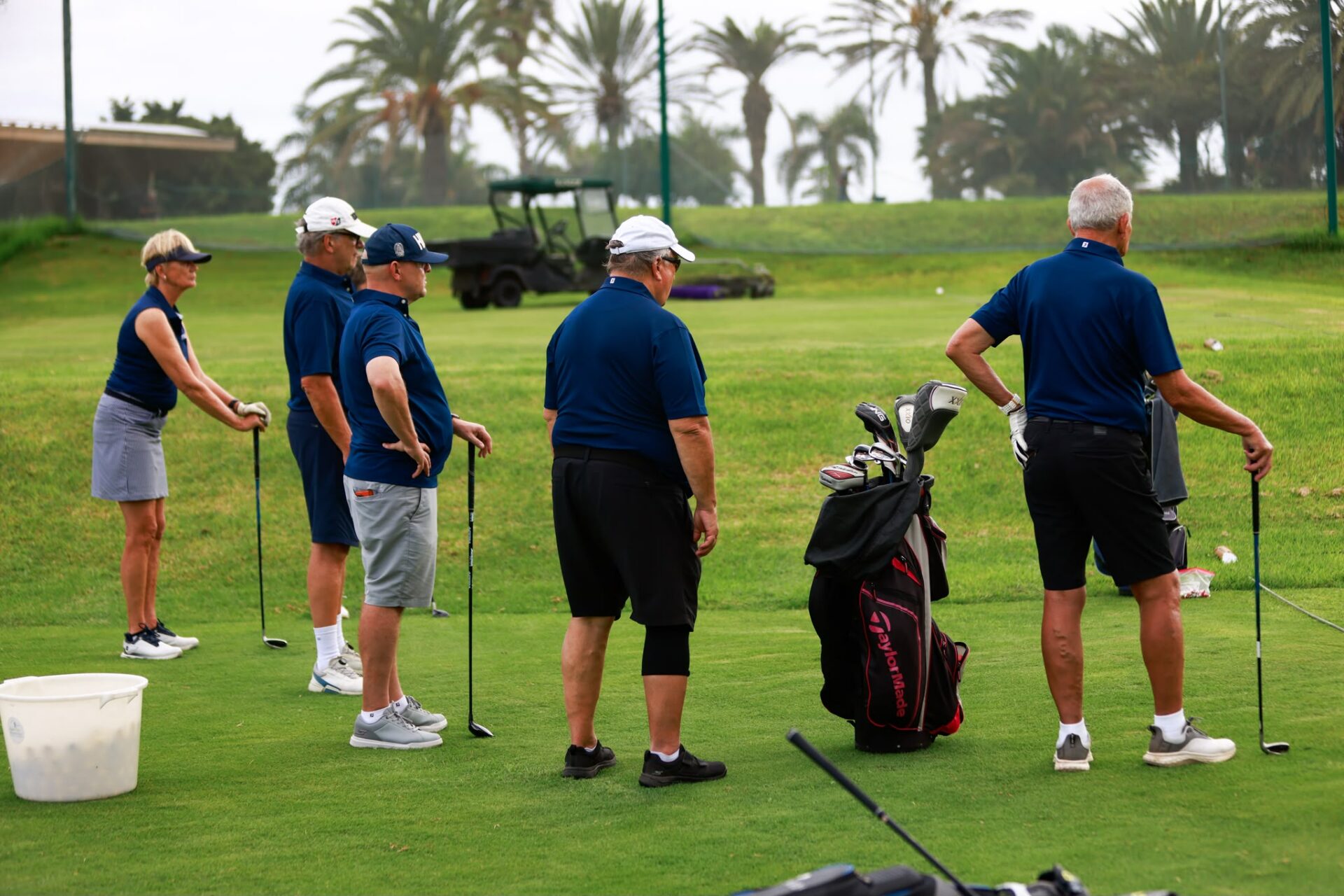

Coaching week in Tenerife, October 2026.
But one question keeps coming up.
Why can you hit the ball beautifully on the driving range, only to lose your swing when you step onto the golf course?
The interesting thing is that the answer isn’t always what you think. Sometimes it’s tension. Sometimes it’s an interrupted routine. Sometimes there’s a genuine technical problem. And sometimes it’s a combination of all three.
That’s why I always start with the same principle. And Ian’s lesson is a particularly good example of why it matters.
What Happened When We Looked at Ian’s Swing?
We started by looking at his movement. At one point, he demonstrated a lovely, smooth swing, and I said to him:
Julian: “You did that beautifully smooth. Great grip, got a really good position. You haven’t slapped it away with your wrist.”
I went on to explain what I was seeing.
Julian: “So that’s an element of coordination, and you’ve got a weight transfer, also a really nice turn of the body.”
But there was something else we needed to investigate. Ian had developed a tendency to rotate his forearms too much during the takeaway, allowing the club to move too far inside. That meant he sometimes had to manipulate the club on the way down to get it back to the ball.
And this is where correct diagnosis becomes so important. We weren’t simply dealing with a golfer who was nervous on the course. We had identified a movement that could also make his shots inconsistent.
So we worked on simplifying the takeaway, allowing his body to turn and his wrists to set without excessive forearm rotation.
During the lesson, Ian produced a shot with a club path of approximately 4.5 degrees in-to-out, virtually no sidespin and an angle of attack of around 1.2 degrees down.
The numbers helped us understand that he was capable of producing a well-coordinated movement. But I wanted him to understand why it was working.
“And It Was Effortless”
As we continued, Ian started producing some lovely shots with his driver. We looked at his takeaway, his grip pressure and the way the club was moving.
At one point, after a particularly good shot, Ian said something that I love hearing from a golfer.
Ian: “And it was effortless. I didn’t feel strength.”
That’s exactly the sort of feeling we’re trying to develop. Not forcing the club. Not trying to manufacture speed. But allowing the movement to become coordinated.
Later, as we looked at the numbers, I said:
Julian: “You’ve got that beautiful whip there as well.”
We saw shots carrying over 200 yards, with one reaching approximately 231 yards.
But here’s the really interesting part. I then asked Ian to deliberately make the incorrect takeaway again. He allowed the club to move too far inside through excessive forearm rotation.
propergolfing.com
Get the Diagnosis Before You Try the Fix
The Timeless Golf Winter Programme gives you two one-hour coaching sessions with PGA Professional Julian Mellor, two simulator practice sessions and a Premier Coaching Experience with a personalised synopsis and practice plan, all built on the Timeless Golf Swing® philosophy. Not in the UK? It can be done on Zoom, with golf swing analysis in place of the simulator.