Rory McIlroy and the
Lesson Every Club Golfer
Needs to Hear
Rory McIlroy has just won his second consecutive Masters. And what he said in his winner’s press conference is the most important thing any golfer — at any level — could hear right now.
Part 1 of 4 · The 85% Series · Why Most Golfers Never Reach Their Potential
The Rory McIlroy Masters 2026 victory was one of the most dramatic in Augusta history — and the lessons it holds for every club golfer are extraordinary. Back-to-back Masters champion. What a moment. What a career. Congratulations, Rory, from all of us at Proper Golfing.
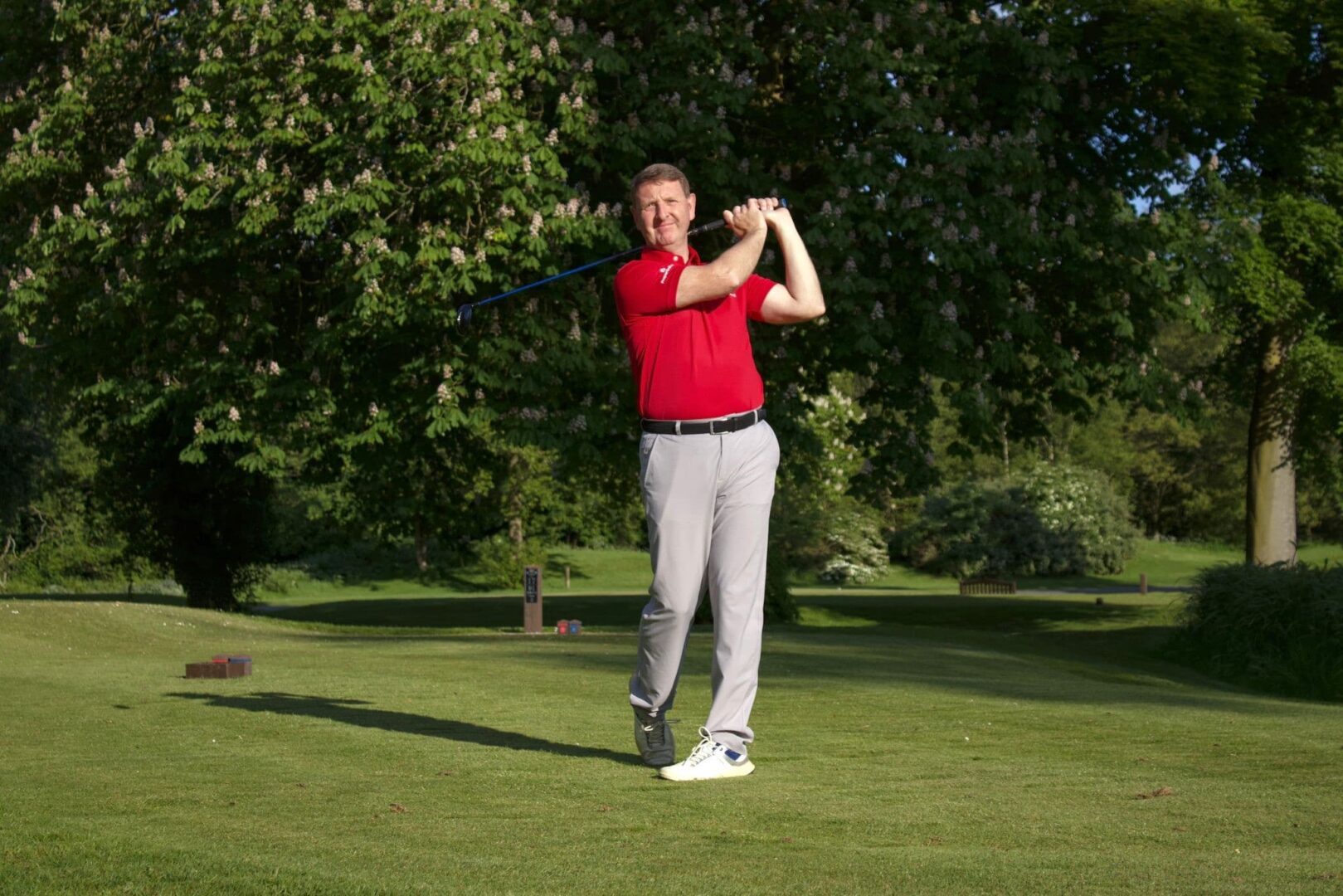
I’ve watched Rory McIlroy for years — as a coach, as a fellow PGA professional, and simply as someone who loves golf. And what happened at Augusta this week moved me. Not just because he won, but because of how he won, and what it took to get there.
Because here’s the thing. Rory McIlroy, one of the most gifted ball-strikers the game has ever seen, has been working with a coach, working on his mind, and working on trusting his swing for years. And on the biggest stage in the world, under the most extraordinary pressure imaginable — he did it. He let it go. He trusted it.
“You have a lot of time to think. You’re out there a long time. There’s a long time between shots. There’s a long time between rounds. Of all the big sports, I think it’s the most mental, the most challenging mentally.”
— Rory McIlroy, winner’s press conference, Augusta 2026The most mental. The most challenging mentally. Those are his words — not mine. And they came from a man who had just won his sixth major, his second consecutive Masters, having led by six shots after Friday and then watched that lead evaporate through the weekend before holding on by one shot. He knows exactly what the mental game costs you. And he said it himself.
The Rory McIlroy Masters 2026 Story — “The Most Challenging Mentally”
I watched every shot on Sunday very carefully — as a coach, not just as a fan. And there was a moment that most commentators glossed over, but that I believe was the turning point of the entire tournament.
After the double bogey on four and the bogey on six, Rory was two over for the day and had lost his overnight lead. That could have been the moment it unravelled. But watch what happened next — he did a mental reset. You could see it in his body language, in the way he stood over the ball on seven. He let it go. He came back to himself. And he birdied seven and eight to get back to even for the day.
— Julian Mellor, PGA Professional · watching the final round“Julian said he was nervous watching — goodness knows what Rory felt like. My knees were shaking!”
— Jo Cameron, Head of Client Experience · Proper GolfingThat mental reset after hole six is, in my view, the real story of this Masters. Not the six-shot lead. Not the final bunker shot on 18. It was the quiet, invisible moment on a Sunday afternoon when one of the world’s best golfers chose not to spiral — chose instead to reset, refocus, and trust what he knows.
That ability — to reset under pressure, to let go of a bad hole and come back to the present — is not something you are born with. It is something you train. It is something you learn. And it is something that 85% of club golfers have never been taught.
Think about what Rory carried into Augusta this week.
The weight of years of near misses. The questions from every journalist, every commentator, every well-meaning fan. The ghost of previous final rounds. The knowledge that the whole world was watching, willing him on — and that same world would notice if he fell short again.That is pressure. Real, crushing, suffocating pressure. You can read the full Augusta National Masters coverage here — but the real story isn’t in the scorecards.
And yet — and this is the lesson — that pressure didn’t come from the golf course. It didn’t come from the bunkers on 18 or the wind off Amen Corner. It came entirely from inside his own head. From expectation. From overthinking. From the very human tendency to make the moment bigger than the shot.
“Pressure is nothing more than the shadow of great opportunity.”
— Michael JohnsonNow here’s the question I want to ask you. When you stand on the first tee on a Saturday morning — not Augusta, just your local course, just your regular Saturday game — how much pressure do you carry? How many thoughts crowd your mind before you even take the club back? How many tips, swing thoughts, YouTube videos, range session memories, and past disasters compete for your attention in the two seconds before impact?
For most club golfers, the answer is: far too many.
What the Rory McIlroy Masters 2026 Final Round Teaches About Overthinking
Rory McIlroy has a coach. He has a sports psychologist. He has a team of people whose entire job is to help him simplify — to strip away the noise and get back to the one feeling, the one thought, the one trust that produces great golf.
Most club golfers have none of that. They have YouTube. They have their playing partner’s well-intentioned advice. They have the memory of a tip they read in a magazine three years ago. And they stand over every shot carrying all of it — a cacophony of contradictory information — and wonder why they can’t find consistency.
According to the R&A, golf participation is growing worldwide — yet the vast majority of players never seek professional guidance. This is the starting point for our new series — because that 85% figure stopped me in my tracks when I first heard it. In what other area of life would you spend years struggling with something, never seek professional help, and simply keep repeating the same patterns hoping for a different result?
And yet that’s exactly what most golfers do, week after week, year after year.
100 Sundays — How the Rory McIlroy Masters 2026 Win Was Built
Cast your mind back to 2023. Rory had just finished second at the US Open at Los Angeles Country Club — another near miss, another Sunday that didn’t quite go his way. And in his post-round press conference, exhausted and disappointed, he said something extraordinary.
“I would go through 100 Sundays like this to get my hands on another major championship.”
— Rory McIlroy, after finishing second at the 2023 US OpenOne hundred painful Sundays. One hundred near misses, one hundred gut-wrenching defeats. And he meant every word.
This weekend at Augusta, he cashed in. All those Sundays — all that patience, all that perseverance, all that work with his coach and his psychologist Bob Rotella — paid off not once, but twice in a row. Back-to-back Masters champion.
There is a lesson buried in that quote that I want every club golfer to take away. Rory didn’t say he would change his swing after 100 failures. He didn’t say he would find a new tip on YouTube, or try a different grip, or give up on the fundamentals. He said he would keep going — keep working, keep trusting, keep showing up — because he believed in the method and the process.
That is what having a coach gives you. Not just technique. Belief in the process.
What Rory Understood That Most Golfers Don’t
The reason Rory finally won The Masters is not because he suddenly discovered a new swing secret on Monday morning. It’s because after years of disciplined work — with a coach, with a clear method, with a structured approach — he reached the point where he could stop thinking and simply play.
That is what great coaching does. It doesn’t give you more to think about. It gives you less. It strips away the confusion, identifies the two or three things that actually matter for your body and your swing, and builds them so thoroughly that they become instinctive — so that when the pressure arrives, the fundamentals are already there, waiting for you.
The three things overthinking does to your golf swing:
- ◆It creates tension — and tension is the single biggest killer of clubhead speed, feel, and consistency
- ◆It slows down your decision-making — you stand over the ball longer, doubt creeps in, and your body tightens
- ◆It disconnects your conscious mind from your natural athletic instinct — the very thing that produces good shots
Rory McIlroy had a coach who helped him work through exactly these things. And on Sunday at Augusta, all of that work paid off in the most public, most dramatic, most beautiful way possible.
What the Rory McIlroy Masters 2026 Win Means for Every Club Golfer
You don’t need to be Rory McIlroy. You don’t need to win The Masters. But you do deserve to stand on the first tee feeling calm, clear, and confident. You deserve to enjoy your Saturday game rather than endure it. You deserve a swing that feels consistent, natural, and yours — not a patchwork of half-remembered tips that fight each other from the first hole to the last.
The Timeless Golf Swing® method that Jo and I have developed over many years is built on exactly this principle — clarity over complexity, freedom over force, trust over tension. It’s been validated by thousands of golfers worldwide, many of whom came to us after years of frustration, carrying exactly the kind of mental baggage that made Rory’s journey so relatable.
And every single one of them — every one — has told us the same thing after working with us. Not “I found a new move” or “I discovered a secret.” They say: “I finally stopped overthinking it.”
“TENSION steals your FEEL and ROBS you of your TALENT.”
— Julian Mellor · Proper GolfingRory McIlroy proved that on Sunday in front of millions. You can prove it on your course, in your game, on your terms — and you don’t have to wait as long as he did to feel it.
Why 85% of Golfers Never Reach Their Potential — And What To Do About It
This article is the first in a series we are building around one of the most striking statistics in golf. More articles are on their way — in the meantime, read our latest blog below.
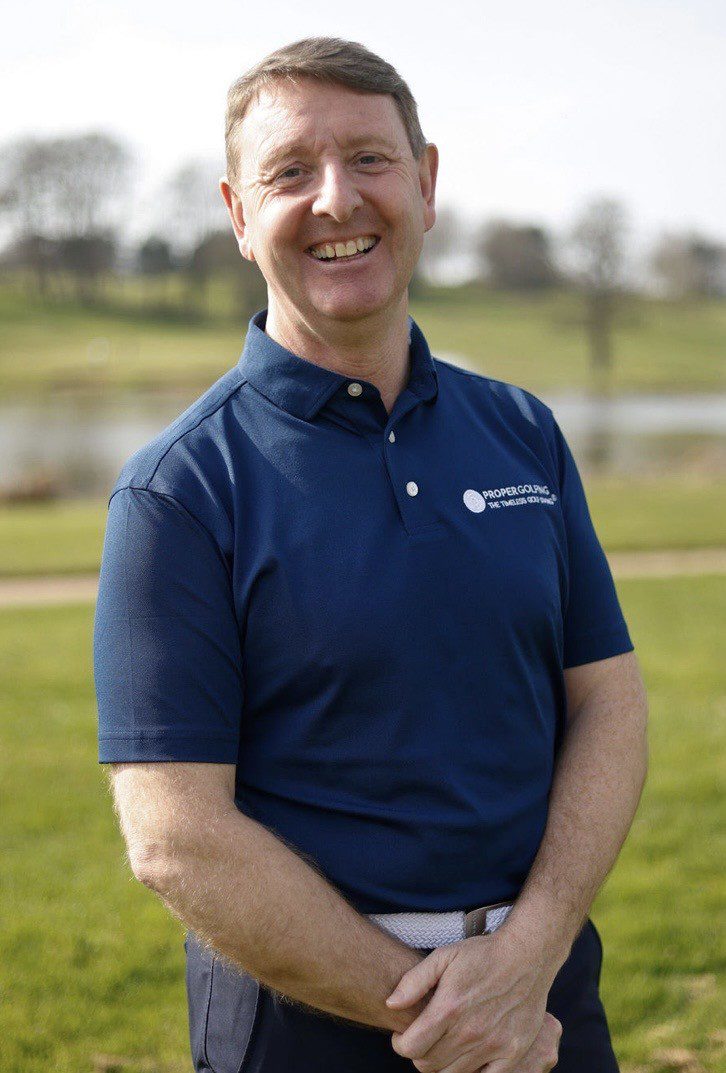
Start Your Own
Transformation Today
Download your free 30-day improvement plan or grab a free sample chapter of The Proper Golfing Handbook — and discover what changes when you finally stop guessing and start trusting.